Advanced Programmes
Advanced Practitioner Certificate in Applied Hair Restoration & Surgical Techniques - For Doctors
Move beyond simply understanding hair loss and develop the clinical thinking required to assess, plan and deliver modern hair-restoration procedures. Build a stronger surgical foundation across diagnosis, medical management, donor harvesting, graft handling and recipient-site design—and take your hair-restoration practice towards a more advanced level.
Tuition Fees
£6,000
Duration: 6 Days
Detailed Theory
In-depth skill building
Clinical observation
Diplomat-led Training
Supervised Clinical Practice
ABOUT THIS COURSE
Course Overview
Hair restoration has become a specialised discipline integrating dermatology, trichology, surgery, pharmacology, and aesthetic judgement, with demand rising sharply: the 2025 ISHRS census reported a 20% increase in patients per member between 2021 and 2024, a 16.5% rise in female surgical patients, and 95% of first‑time patients aged 20–35. For doctors, this field requires more than graft extraction and implantation — it demands mastery of hair biology, alopecia classification, pharmacological treatments, patient assessment, donor management, FUT/FUE principles, graft preservation, recipient‑site design, anaesthesia, perioperative care, and clinical governance. Commercially, the global hair‑transplant market is projected at USD 9.10 billion in 2025 with continued growth, and ISHRS members averaged 178 surgeries in 2024 (around 15 per month), underscoring both the clinical intensity and economic significance of this expanding specialty.
What You'll Learn?
Course Details
The Advanced Practitioner Certificate in Applied Hair Restoration & Surgical Practice is designed for doctors seeking a structured foundation in modern hair‑restoration. It begins with hair‑follicle biology, diagnosis, classification, and treatment selection, covering androgenetic alopecia and other causes of hair loss, trichoscopy, and pharmacological/non‑surgical options such as minoxidil, finasteride, dutasteride, PRP, and regenerative therapies—ensuring treatment planning starts with accurate diagnosis rather than defaulting to surgery.
The surgical pathway then addresses donor‑area assessment, FUT, FUE, BHT, hybrid harvesting, graft handling, recipient‑site design, hairline architecture, density, angulation, and placement techniques, alongside anaesthesia, perioperative care, infection prevention, complication management, documentation, and follow‑up. The programme also integrates emerging technologies, evidence appraisal, ethics, clinical governance, and quality improvement, reflecting ISHRS standards for professional practice in hair‑restoration surgery.
The Certificate in Anatomy, Physiology and Pathology for Aesthetic Medicine is delivered through a blended academic and clinical model, combining structured theoretical learning with supervised applied practice. Assessment is evidence-based and mapped against nationally recognised qualification standards.
What You'll Study?
Module 1 — Foundations of Hair Restoration Science
This module builds the scientific base by covering scalp anatomy, follicular biology, and the hair‑growth cycle. You will learn how miniaturisation leads to hair loss and how regeneration principles apply clinically. Scientific foundations of transplantation are introduced to connect biology with surgical outcomes. By the end, you’ll understand the biological factors that influence treatment success.
Module 2 — Hair Loss Diagnosis and Classification
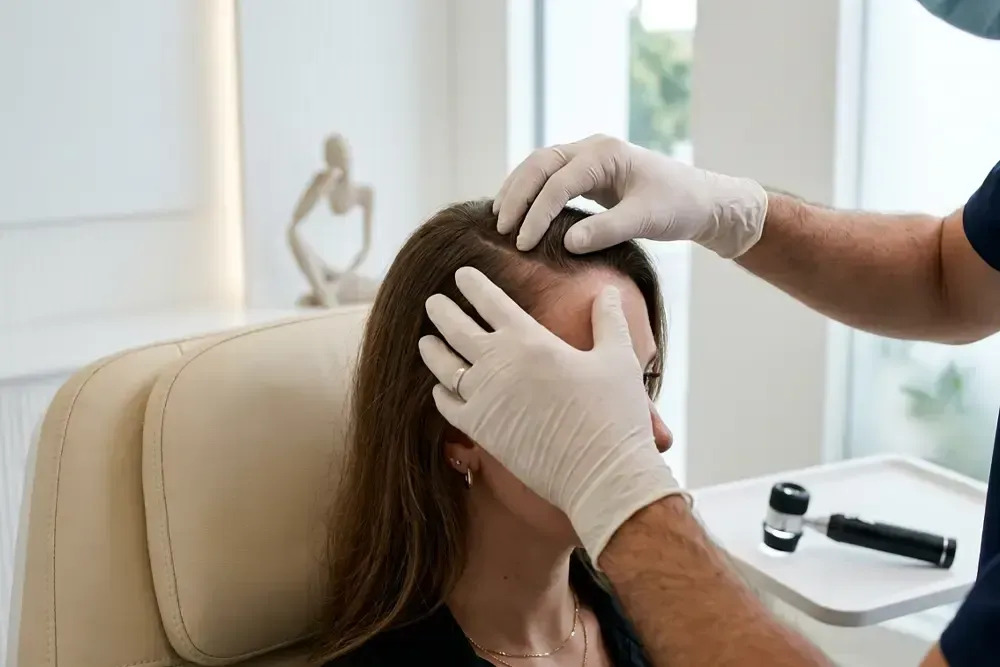
Here you study causes and patterns of hair loss, including androgenetic alopecia, alopecia areata, and scarring types. Clinical history, examination, and trichoscopy are taught as diagnostic tools. Classification systems and differential diagnosis guide treatment decisions. You’ll learn when to investigate further or refer, ensuring accurate diagnosis before intervention.
Module 3 — Pharmacological and Non-Surgical Hair Restoration
This module focuses on medical management with minoxidil, finasteride, dutasteride, and counselling for informed decisions. You’ll explore monitoring, adverse effects, and safety considerations. PRP and regenerative approaches are introduced alongside emerging therapies. Long‑term maintenance strategies ensure continuity of care beyond surgery.
Module 4 — Patient Assessment and Treatment Planning
Comprehensive assessment covers medical history, donor density, and recipient‑area analysis. You’ll learn graft estimation, donor conservation, and hairline design principles. Treatment objectives and staged procedures are aligned with patient expectations. Informed counselling and consent are emphasised to build trust and clarity.
Module 5 — Anaesthesia and Clinical Preparation
This module teaches principles of local anaesthesia and tumescent infiltration. Pharmacology and safe administration are reinforced with monitoring protocols. You’ll learn to recognise adverse reactions and prepare for emergencies. Documentation and perioperative safety complete the clinical preparation framework.
Module 6 — Donor Harvesting Techniques
You’ll study FUT, FUE, body‑hair transplantation, and hybrid harvesting approaches. Donor‑area planning and instrument selection are taught for precision. Punch characteristics, graft transection, and tissue damage prevention are emphasised. The focus is on donor conservation and harvesting quality.
Module 7 — Graft Handling and Viability
This module covers follicular‑unit identification, dissection, and classification. Preservation techniques include hydration, temperature control, and storage principles. Atraumatic handling minimises follicular damage during surgery. The goal is maintaining graft viability throughout the procedure.
Module 8 — Recipient Site Design and Graft Placement
Recipient‑area assessment guides hairline architecture and density planning. You’ll learn direction, angulation, and regional distribution of grafts. Techniques include lateral slits, micro‑blades, and implanters. High‑density transplantation and precise placement ensure natural results.
Module 9 — Perioperative and Post-Operative Patient Care
This module covers preparation, intraoperative assistance, and infection prevention. Wound care, graft protection, and post‑operative instructions are emphasised. You’ll learn to recognise and manage complications early. Documentation, photography, and follow‑up protocols ensure long‑term patient monitoring.
Module 10 — Innovation, Ethics and Practice Development
Emerging technologies and regenerative approaches are introduced. Evidence appraisal and clinical governance strengthen professional competence. Ethical decision‑making, regulatory considerations, and quality improvement are explored. The module concludes with responsible practice development and outcome evaluation.
Key Information

Entry Requirements
• Applicants must be registered medical doctors or hold an equivalent recognised medical qualification appropriate to their jurisdiction.
• A current professional registration or licence to practise medicine is expected.
• Applicants should have an interest in, or existing exposure to, dermatology, aesthetics, surgery, trichology or hair restoration.
• A foundational understanding of anatomy, physiology, pharmacology and clinical patient assessment is expected.
• Applicants must be prepared to undertake clinical learning within their professional scope, local regulations, insurance requirements and appropriate clinical governance arrangements.
Our Teaching Approach
• Science before surgery: Build a strong understanding of hair biology, pathology and diagnosis before progressing into advanced surgical principles.
• Clinically integrated learning: Connect patient assessment, medical treatment, surgical planning, harvesting, graft handling, implantation and aftercare into one complete clinical pathway.
• Evidence and professional judgement: Develop the ability to evaluate treatment options, recognise limitations, manage risk and make responsible clinical decisions rather than following procedural techniques mechanically.
Progression Route
• Advanced Hair-Restoration Practice: Use the programme as a structured foundation for developing your clinical role within hair restoration and integrating medical and surgical treatment planning.
• Clinical Fellowship in Applied Hair Restoration & Surgical Practice: Progress into supervised clinical surgical experience, developing practical competence through observed and supervised hair-transplant procedures.
• Postgraduate progression: Build towards higher-level academic and professional study in trichology, hair restoration and related fields, including postgraduate qualifications where the relevant entry requirements are met.
Eligible Roles
Who We Train
Doctors
Physician
Associates
Nurses
Dentists
Allied Health Professionals
Beauty Therapists
Aspiring Aesthetic Practitioners
Recognised Training & Qualifications
Accreditation & Validation

book your coursE
Upcoming Training Dates
Reserve your place today and take the first step towards advancing your knowledge and practice. Places are limited and fill quickly, so early enrolment is strongly encouraged to avoid disappointment. Enrol now to gain immediate access to your online study materials and complete your practical training at a time that suits you.
CUSTOM SCHEDULING OPTIONS
Can't Make These Dates?
Please share your preferred month and availability, and we will be in touch to confirm suitable training dates. Your response will help us shape our upcoming course schedule around the needs of our learners.
Tell us your preferred date
If the current dates for this course do not work for you, tell us what would and our admissions team will follow up.

Real Results | Real Delegates
What Our Delegates Say?
WE'RE HERE TO HELP
Not Sure Where to Start?
Taking the first step towards a new career can feel overwhelming and that is completely normal. Our academic team is here to make that decision easier for you.
Book your free consultation today and get personalised guidance on course eligibility, professional pathways, tuition fee instalments, and available discounts.
Your future starts with one conversation.
Let's talk.
Download Course Brochure
Receive immediate access to our latest curriculum overview, entry requirements, fees, and flexible schedules.
We have sent a copy of the prospectus directly to your email address. You should receive it momentarily.
If it doesn't arrive within a couple of minutes, please check your spam or junk folder.
Frequently Asked Questions
Everything You Need to Know
The Certificate in Anatomy, Physiology and Pathology for Aesthetic Medicine is delivered through a blended academic and clinical model, combining structured theoretical learning with supervised applied practice. Assessment is evidence-based and mapped against nationally recognised qualification standards.
1. Who is this programme designed for?
This programme is specifically designed for doctors who want to develop advanced knowledge of hair restoration and the principles underlying modern hair-transplantation practice. It is particularly suitable for doctors developing an interest in trichology, aesthetic medicine, dermatology or hair-restoration surgery.
2. Is this a hair-transplant surgery course?
It is a comprehensive applied hair-restoration and surgical practice programme covering the scientific, diagnostic, medical and surgical principles behind contemporary hair transplantation. It includes FUT, FUE, BHT, graft handling, recipient-site design, placement, anaesthesia and perioperative care. Practical surgical competence requires appropriate supervised clinical experience in addition to theoretical study.
3. Will I learn both FUE and FUT?
Yes. The curriculum covers the principles and clinical application of Follicular Unit Extraction (FUE) and Follicular Unit Transplantation (FUT), alongside body hair transplantation and hybrid approaches. The aim is to help doctors understand when different approaches may be appropriate and how donor conservation and graft quality influence treatment planning.
4. Will the programme teach me how to diagnose hair loss before recommending transplantation?
Yes. Diagnosis is deliberately placed early in the programme. You will study clinical history, examination, classification, trichoscopy, differential diagnosis and referral considerations. This is essential because transplantation is not appropriate for every patient presenting with hair loss.
5. What medical treatments for hair loss are covered?
The programme examines established and emerging non-surgical approaches, including minoxidil, finasteride, dutasteride, PRP and regenerative therapies. The emphasis is on treatment selection, patient counselling, safety, monitoring and long-term management rather than simply listing available treatments.
6. Why is donor-area assessment so important?
Hair transplantation redistributes a finite resource. Poor donor assessment or excessive harvesting can compromise future treatment options and produce visible donor depletion. The programme therefore covers donor density, donor quality, conservation, graft estimation and long-term planning as central components of surgical decision-making.
7. Does completing this CPD programme make me a specialist hair-transplant surgeon?
No. Completion demonstrates structured education in the subject but should not be represented as equivalent to specialist medical registration, specialist accreditation or extensive supervised surgical experience. Safe independent practice requires appropriate clinical training, supervised experience, competence assessment, insurance and compliance with the regulations and governance requirements applicable to your jurisdiction.
8. What can I progress to after completing the programme?
Doctors can use the programme as a foundation for further supervised clinical development, including a Clinical Fellowship in Applied Hair Restoration & Surgical Practice, as well as broader postgraduate study in trichology and hair restoration. The appropriate route will depend on your existing qualifications, clinical experience and the entry requirements of the next programme.
Courses You Might be Interested In
Explore Related Course

Hamilton House
4 Mabledon Place
Bloomsbury
London WC1H 9BB
United Kingdom





Copyright © 2026 Harley Institute of Aesthetics. All rights reserved.